המכון הישראלי למדיניות טכנולוגיה (FPF – Israel) הגיש את הערותיו לרשות להגנת הפרטיות בנוגע ל”טיוטת גילוי דעת בנושא הסכמה בדיני הגנת הפרטיות”.
עמדת המכון היא כי בעידן הנוכחי, קבלת הסכמה אמיתית ומדעת, כפי שנדרש בחוק, הפכה למורכבת בשל ההתפתחויות הטכנולוגיות, היקף עיבוד המידע, תדירותו והקושי להציג לנושא המידע את כלל הפעולות באופן בהיר ומובן.
לפיכך, המכון סבור כי יש להוסיף עוגנים נוספים להסתמכות על הסכמה והיתר מכוח הדין – שהם כיום הבסיס הבלעדי בדין הישראלי – בדומה למודלים הנהוגים במדינות מערביות אחרות.
דרך המלך היא תיקון חקיקה ראשי. בהיעדר תיקון כאמור, ולאור הפער ההולך וגדל בין הפרקטיקה להוראות החוק, מציע המכון לאמץ גישה פרשנית עדכנית. גישה זו תאפשר הכרה בעוגנים נוספים, בין היתר בהתבסס על חלק מסעיפי ההגנה בסעיף 18 לחוק הגנת הפרטיות, ובהתחשב בהכרה הקיימת בדין הישראלי בהסכמה מכללא.
הפרשנות המשפטית המוצעת מפורטת בעמדת המכון, אשר נכתבה על ידי עו”ד רבקי דב”ש, עמיתה בכירה במכון. בנוסף, העמדה כוללת הערות קונקרטיות ביחס לפרשנות שניתנה על ידי הרשות בגילוי הדעת.
לעיון במסמך המלא כפי שנשלח לרשות להגנת הפרטיות כאן.
webinar Summary: Data Subject’s Rights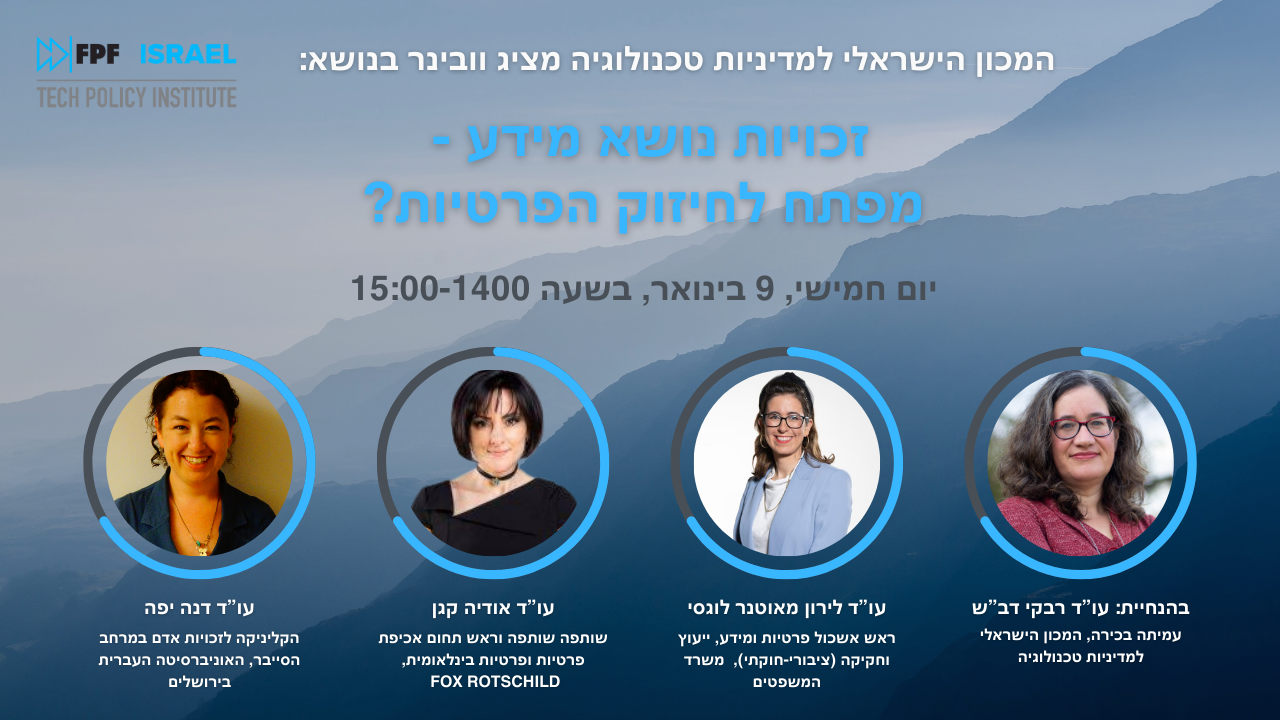
On January 9, 2025, FPF-Israel held a webinar on “Data Subject’s Rights – A Key to Strengthening Privacy?”.
The panel included the following speakers:
Adv. Liron Mautner-Lugasi, Senior Director of Privacy and Data Division, Department of Public and Constitutional Law, Ministry of Justice;
Adv. Odia Kagan, Partner and Chair of Data Privacy Compliance & International Privacy at Fox Rothschild (USA);
Adv. Dana Yaffe, Director of The Clinic on Human Rights Clinic in Cyberspace, The Hebrew University of Jerusalem.
The panel was moderated by Adv. Rivki Dvash is a senior fellow at FPF-Israel.
A written summary of the main points raised in the webinar is presented for your convenience.
Those interested can watch the recording (in Hebrew) at this link.
Opening remarks:
The webinar was born in the wake of Amendment No. 13 to the Israeli Privacy Law, which strengthened the ability to enforce in Israel and the understanding that the upcoming amendment that the Ministry of Justice will promote will also regulate substantive issues.
In this webinar, we examined whether upholding the rights of data subjects can help increase data protection in Israel. We invited three spokeswomen from different disciplines.
Adv. Liron Mautner-Lugasi:
Adv. Mautner-Lugasi reviewed the theoretical and normative perceptions of the data subject’s rights in Israel.
Highlights:
Data protection is considered a legal and social tool that allows a person freedom of expression and protection from the concentration of power of commercial and governmental entities. The rights of data subjects in Israel are relatively limited compared to the European GDPR. Amendment 13 was enacted primarily to improve the enforcement of the legal arrangement in Israel.
Adv. Mautner-Lugasi presented the Israeli legislation on data rights, including the right to access data (section 13), the right to rectify data (section 14), the obligation of the controller to notify when collecting data (section 11), which was expanded in Amendment No. 13, and special rights regarding the use of data in databases for direct marketing and direct marketing services (17c-17f).
The Privacy Regulations (Provisions Regarding Data Transferred to Israel from the European Economic Area), 5783-2023 (the Mediation Regulations), which came into full effect on January 1, 2025, apply to databases containing data from the European region. The regulations have created an anomaly because they apply only to some databases. Therefore, they are called mediation regulations because, as far as the Ministry of Justice is concerned, this is a temporary situation and not optimal.
The expansion of data subject rights in the Regulations touches on several aspects, including the expansion of the right to deletion, the obligation to minimize the data held in the database, the obligation to ensure the accuracy of the data in the databases, and the expanded duty to inform.
In addition to the Privacy Act, specific legal arrangements in Israel establish unique rights for data subjects, such as the Criminal Information Law, the Financial Data Service Law, the Credit Data Law, etc.
In conclusion, Adv. Mautner-Lugasi elaborated on the existing anchors in Amendment No. 13 that strengthen the ability to carry out administrative or private enforcement of a violation of data subject rights while mentioning a legislative amendment that is expected to expand the ability to file class actions on this issue.
Adv. Odia Kagan
Adv. Kagan presented the leading approach in the United States regarding the protection of data subjects’ rights and its uniqueness, especially vis-à-vis the European approach.
Highlights:
The main difference in the perception of data protection between the United States and Europe is that in Europe, data protection is perceived as a fundamental human right, while in the United States, data protection focuses on the issue of your agency and role as a consumer. The emphasis is on the consumer as a user of services in the market.
According to Adv. Kagan’s analysis, the free market is the basis in the U.S. for the perception of data subject rights. People are the basic unit of society’s functioning, and their free choice drives the market.
Today, technological advances have the ability to “disrupt” a person’s decision through various manipulations. Therefore, American regulation focuses on removing the “defects” that divert or influence a person’s agency by emphasizing transparency and non-deception to allow a person to make an honest, free choice.
Another emphasis is on the “sale” of information, where most enforcement was done in the United States. There is increasing importance placed on the rights of deletion, correction of information, and tracking of data transfers between various entities. The emphasis here is on the monetization of information. Because you did not give the person the choice, he could not anticipate the transfer, and you did not give him the option to object or condition it. There is extensive writing on the subject in the United States and significant enforcement in these areas.
The issue of choice is acute; therefore, there is enforcement where there is deception or unfair influence on the selection considerations (such as dark patterns).
Adv. Kagan emphasized that in the United States, especially after the change of leadership at the FTC, the impact of information on the person is examined. The fact that data is being processed, if it has no impact in reality, does not concern American regulation. Where the processing of sensitive information will have an impact on a person’s life, for example, medical treatment, employment, etc., or if the circumstances of the collection or use involve deception, they will be stricter in checking the processing of information to ensure that it is done transparently and fairly vis-à-vis the consumer.
The concept is not that the state gives a person rights but that you have rights by your “being,” and you are giving the state permission to help you be more protected. Therefore, the purpose of the laws is to provide you with the tools to make informed decisions as they were in the past. That is why, in the United States, the focus is on transparency, preventing patterns that prevent the possibility of making an informed decision, monetization that you do not expect, and in cases where the use of information has a consequence that may cause harm.
Adv. Dana Yaffe
Adv. Yaffe presented the difficulties in practically implementing standing up for rights in virtual space.
Highlights:
Adv. Yaffe emphasized the gaps between existing legislation and the practical complexity of implementing individual rights in the digital space in Israel.
The three main barriers are the law enforcement authorities and their modus operandi, the need to deal with foreign platforms that do not cooperate in many cases, and the international effect of the space.
Incidentally, Adv. Yaffe would like to point out that sometimes the harm also occurs to someone who is not a “consumer” of digital media (such as someone whose intimate photos were distributed on a network in which he is not a member). Therefore, relying on consumer’s perception and user’s consent is insufficient.
Adv. Yaffe presented several examples of cases she handled and the difficulties she experienced during the treatment of these cases.
In her view, beyond the amendment to the Privacy Law, more effective enforcement tools are necessary in Israel, similar to the DSA (Digital Services Act) laws in Europe, which impose liability on digital content intermediaries. In addition, Adv. Yaffe emphasized the gaps in protecting individual rights in the online space in Israel and asked for regulatory reinforcement to better deal with digital abuses (for example, the right to be forgotten).
As for the tool of class actions and civil lawsuits in general, they can usually be used only after the injury and evidence about it have become known. Otherwise, it is challenging to prove a violation of data protection in a company that protects its trade secrets when the defendant can always bring in more knowledgeable experts to contradict the plaintiffs’ claims.
A joint discourse at the end
In conclusion, Adv. Dvash. Asked what the spokespersons would recommend as anchors for future legislation in Israel on the subject:
Adv. Kagan emphasizes the importance of transparency without misleading the way information is presented to the user. Based on the perception that the regulator should allow the individual to make autonomous decisions, the solution is to empower the person and not focus only on restricting the business. Another emphasis is on the actual impact—to intervene where the use of the information impacts people’s reality.
Adv. Yaffe feels there is a lack of a law similar to the DSA that provides effective tools to act vis-à-vis companies. It is also necessary to train law enforcement agencies, especially the police, to act in such offenses. It must be remembered that there are platforms that don’t comply with Israeli law, and then there is a need for international cooperation to create deterrence in the field.
Adv. Mautner-Lugasi noted that the data subject’s rights are one of several tools that can improve data protection. It is impossible to impose everything on a person and be satisfied that he may realize his rights. Strengthening administrative enforcement is an example of another such tool. We need to promote and develop additional tools and principles, and a combination of all of these will succeed in bringing about change.
סיכום וובינר: זכויות נושא מידעב 5 באוגוסט 2024, אישרה מליאת הכנסת את הצעת חוק הגנת הפרטיות (תיקון מס’ 13), התשפ”ד-2024 (לתקציר הוובינר בנושא זכויות נושא מידע
ב-9 בינואר 2025 קיים המכון הישראלי למדיניות טכנולוגיה וובינר בנושא “זכויות נושא מידע – מפתח לחיזוק הפרטיות?”.
בפאנל השתתפו הדוברות הבאות:
עו”ד לירון מאוטנר-לוגסי, ראש אשכול פרטיות ומידע, ייעוץ וחקיקה (ציבורי-חוקתי), משרד המשפטים;
עו”ד אודיה קגן, שותפה וראש תחום אכיפת פרטיות ופרטיות בינלאומית, במשרד עוה”ד Fox Rothschild(USA);
עו”ד דנה יפה, הקליניקה לזכויות אדם במרחב הסייבר, האוניברסיטה העברית בירושלים.
את הפאנל הנחתה עו”ד רבקי דב”ש, עמיתה בכירה במכון הישראלי למדיניות טכנולוגיה.
לנוחיותכם, מובא תקציר כתוב של עיקרי הדברים שעלו בוובינר.
למעוניינים, ניתן לצפות בהקלטה בקישור זה.
דברי פתיחה:
הוובינר נולד בעקבות תיקון מס’ 13 לחוק הגנת הפרטיות בישראל, אשר חיזק את יכולת האכיפה בישראל, והבנה כי התיקון הקרוב שמשרד המשפטים יקדם, יסדיר גם נושאים מהותיים.
בוובינר זה ביקשנו לבחון האם עמידה על זכויות נושא מידע יכול לסייע בהגברת הפרטיות בישראל, ולשם כך הזמנו שלוש דוברות מדיצפלינות שונות.
עו”ד לירון מאוטנר-לוגסי:
עו”ד מאוטנר-לוגסי סקרה את התפיסה בישראל ביחס לזכויות נושא מידע ברמה התיאורטית ואת המצב הנורמטיבי הקיים בישראל.
עיקרי הדברים:
פרטיות נחשבת לכלי משפטי וחברתי המאפשר לאדם חופש ביטוי והגנה מפני ריכוזיות כוח של גופים מסחריים ושלטוניים. זכויות נושאי מידע בישראל מוגבלות יחסית בהשוואה לתקנות ה-GDPR האירופאיות. תיקון 13 חוקק בעיקרו כדי לשפר את אכיפת ההסדר החוקי בישראל.
עו”ד מאוטנר-לוגסי הציגה את החקיקה הישראלית בנושא זכויות מידע ובכלל זה זכות העיון במידע (סעיף 13) ותקנות העיון, זכות תיקון המידע (סעיף 14) וחובת יידוע בעת איסוף מידע (סעיף 11) אשר הורחבה בתיקון מס’ 13, זכויות מיוחדות סביב שימוש במידע במאגרים לשירותי דיוור ישיר ודיוור ישיר (17ג-17ו).
תקנות הגנת הפרטיות (הוראות לעניין מידע שהועבר לישראל מהאזור הכלכלי האירופי), תשפ”ג-2023 (תקנות הגישור), אשר נכנסו למלואן לתוקף ב-1 בינואר 2025, חלות על מאגרים שיש בהם מידע שהגיע מהאיזור האירופי. התקנות יצרו אנומליות מסוימת מכיוון שהן חלות רק על חלק מהמאגרים, ולכן נקראות תקנות גישור, כי מבחינת משרד המשפטים זה מצב זמני ולא מיטבי.
ההרחבה על זכויות נושא מידע בתקנות נוגע במספר היבטים ביניהם הרחבה של הזכות למחיקה, לצידה חובה של מיזעור המידע המוחזק במאגר, חובת דיוק המידע במאגרים וחובת יידוע מורחבת.
לצד חוק הגנת הפרטיות יש הסדרים חוקיים ספציפיים בישראל הקובעים זכויות ייחודיות לנושאי מידע כגון חוק המידע הפלילי, חוק שירות מידע פיננסי, חוק נתוני אשראי וכד’.
לסיום הרחיבה עו”ד מאוטנר-לוגסי לגבי עוגנים הקיימים בתיקון מס’ 13 המחזקים את היכולת לבצע אכיפה מינהלית או פרטית על הפרה של זכויות נושא מידע, תוך איזכור תיקון חקיקה הצפוי להרחיב את יכולת הגשת תובענות ייצוגיות בנושא זה.
עו”ד אודיה קגן
עו”ד קגן הציגה את התפיסה המובילה בארה”ב ביחס להגנה על זכויות נושא מידע והייחודיות של תפיסה זו במיוחד אל מול התפיסה האירופית.
עיקרי הדברים:
ההבדל המרכזי בתפיסת הפרטיות בין ארה”ב לאירופה היא שבאירופה פרטיות נתפסת כזכות יסוד של האדם, בעוד בארה”ב ההגנה על פרטיות מתמקדת בנושא המידע כצרכן. הדגש הוא על הצרכן כמשתמש בשירותים בשוק.
על פי הניתוח של עו”ד קגן – הבסיס בארה”ב לתפיסת זכויות נושא מידע הוא השוק החופשי. אנשים הם היחידה הבסיסית בתפקוד החברה והבחירה החופשית שלהם היא מה שמניע את השוק.
כיום יש יכולות “לשבש” את החלטתו של האדם על ידי מניפולציות שונות. ולכן הרגולציה האמריקאית מתמקדת בהסרת “הקלקולים” שמסיטים או משפיעים על בחירתו של האדם באמצעות דגש על שקיפות ואי הטעייה, על מנת לאפשר לאדם בחירה חופשית כנה.
דגש נוסף הוא על “מכירת” מידע (sale), שם היה עיקר האכיפה בארה”ב. הכוונה היא להעברת מידע בין גופים בו הגוף שמקבל את המידע עושה בו שימוש לתועלתו שלו – גם ללא תמורה. קיימת חשיבות גוברת לזכויות מחיקה, תיקון מידע ומעקב אחרי העברות נתונים בין גופים שונים. הדגש כאן הוא על המונטיזציה של המידע. העובדה שלא נתת לאדם את הבחירה, הוא לא יכל לצפות את ההעברה ולא נתת לו בחירה להתנגד או להתנות עליה. יש בארה”ב כתיבה נרחבת בנושא, ואכיפה משמעותית בתחומים אלו.
נושא הבחירה הוא אקוטי ולכן יש אכיפה במקום שיש בו הטעיה או השפעה לא הוגנת על שיקולי הבחירה (כגון dark patterns).
עו”ד קגן הדגישה כי בארה”ב ביחוד לאחר חילופי ההנהגה בFTC, בודקים מהי ההשלכה על השימוש במידע על האדם. העובדה שנעשה עיבוד מידע, אם אין לו השלכה במציאות אינו מעסיק את הרגולציה האמריקאית. במקום בו תהיה לעיבוד מידע רגיש השלכה על חייו של אדם, לדוגמא: טיפול רפואי, קבלה לעבודה וכד’, או אם נסיבות האיסוף או השימוש כרוכות בהטעייה, יחמירו יותר בבדיקת עיבוד המידע לוודא שהוא נעשה באופן שקוף והוגן אל מול הצרכן.
התפיסה אינה שהמדינה נותנת לאדם זכויות אלא שאתה בעלי זכויות מעצם היותך ואתה נותן הרשאה למדינה לסייע לך בהגנה עליהן. לכן מטרתם של החוקים היא לתת לך את הכלים לקבל את ההחלטות המושכלות כפי שהיה בעבר. זו הסיבה שבארה”ב מתמקדים בשקיפות, במניעת דפוסים המונעים אפשרות לקבל החלטה מושכלת, מונטיזציה שאין לך ציפיה לגביה, ובמקרים בהם לשימוש במידע יש השלכה שעשויה לגרום לנזק.
עו”ד דנה יפה
עו”ד יפה הציגה את הקשיים ביישום מעשי של עמידה על זכויות במרחב הווירטואלי.
עיקרי הדברים:
עו”ד יפה הדגישה את הפערים בין חקיקה קיימת למורכבות המעשית של יישום זכויות פרט במרחב הדיגיטלי בישראל.
שלושת החסמים המרכזיים: רשויות אכיפת החוק ודרך הפעולה שלהם, הצורך להתמודד עם פלטפורמות זרות שבמקרים רבים אינן משתפות פעולה, והאפקט הבינ”ל של המרחב שיש בו חסמים.
אגב התפיסה האמריקאית, מבקשת עו”ד יפה להעיר כי לפעמים הפגיעה מתרחשת גם למי שאינו “צרכן” של המדיה הדיגיטלית (כגון מי שתמונות אינטימיות שלו הופצו ברשת בה הוא לא חבר), ולכן תפיסת הצרכן אינה מספקת.
עו”ד יפה הציגה מספר דוגמאות ממקרים שהיו בטיפולה ואת הקשיים אותם חוותה במהלך הטיפול במקרים אלו.
לתפיסתה, מעבר לתיקון בחוק הגנת הפרטיות, יש לדאוג כי יהיו בישראל כלי אכיפה יעילים יותר, בדומה לחוקי ה-DSA (Digital Services Act) באירופה, המטילים אחריות על מתווכי תוכן דיגיטלי. כמו כן, עו”ד יפה הדגישה את הפערים הקיימים בהגנה על זכויות הפרט במרחב המקוון בישראל, וביקשה חיזוק רגולטורי לשם התמודדות טובה יותר עם פגיעות דיגיטליות (לדוגמא, הזכות להשכח).
לגבי הכלי של תובענות ייצוגיות ותביעות אזרחיות בכלל, בדרך כלל ניתן לעשות בהם שימוש רק לאחר היוודע קיומה של פגיעה וקיומן של ראיות אודותיה. אחרת מאוד קשה להוכיח טכנולוגית פגיעה בפרטיות בחברה ששומרת על סודותיה המסחריים, כאשר הנתבע יכול תמיד להביא מומחים בקיאים יותר לסתור את טענות התובעים.
שיח משותף לסיום
לסיום שאלה עו”ד דב”ש מה הדוברות היו ממליצות כעוגנים לחקיקה העתידית בישראל בנושא:
עו”ד קגן שמה דגש על חשיבות השקיפות ללא הטעיה באופן הצגת המידע למשתמש, וזאת מתוך תפיסה שהרגולטור צריך לאפשר לאדם לקבל החלטות אוטונומיות. הפתרון הוא להעצים את האדם, ולא להתמקד רק בהגבלת העסקים. דגש נוסף הוא על האימפקט בפועל – להתערב במקום בו השימוש במידע משליך על המציאות של אנשים.
עו”ד יפה מרגישה בחיי המעשה חסר בחוק דומה ל-DSA שנותן כלים אפקטיביים לפעול מול החברות. כמו כן יש צורך להכשיר את גורמי האכיפה ובראשם המשטרה, לדעת לפעול בעבירות מסוג זה. צריך לזכור שיש פלטפורמות עברייניות, ואז יש צורך בשיתוף פעולה בינ”ל כדי לייצר הרתעה בתחום.
עו”ד מאוטנר-לוגסי ציינה שזכויות נושא המידע הוא כלי אחד מני כמה שיש בו כדי לשפר את רמת הפרטיות. אי אפשר להשית את הכל על האדם ולהסתפק בכך שיתכן ויממש את זכויותיו.לכן, לצד חיזוק זכויות נושאי המידע יש לקדם כלים נוספים שיגבירו את רמת הפרטיות בישראל. חיזוק האכיפה המנהלית הוא דוגמא לכלי נוסף כזה. צריך לקדם ולפתח כלים ועקרונות נוספים, כאשר שילוב של כל אלה יצליח להביא לשינוי.
FPF-Israel Annual recap-2024 in Review
Overview
As 2024 draws to a close, we reflect on a year of unprecedented challenges, set against the backdrop of political, social, and security crises that have shaken the Middle East. The region faced a range of complex issues, unlike anything seen before, with security concerns taking center stage and pushing privacy matters to the periphery.
Despite this turbulent environment, FPF-Israel has persevered in addressing the pressing challenges the crisis has brought to light, particularly about memory and commemorative aspects and the delicate balance between national security, privacy and data protection.
Amid ongoing crises, Israel’s privacy protection law was significantly amended, primarily focused on significantly empowering the Privacy Protection Authority to effectively address the growing challenges of data protection in the 21st century. These changes help align Israel’s privacy standards with global norms, despite geopolitical instability.
Though 2024 was a year of hardship, FPF-Israel’s resilience and dedication to its mission have remained steadfast. By continuing to advocate for privacy in an era of rapid technological advancements and security concerns, FPF-Israel has shown that even in the most difficult of times, the future of privacy must remain a priority.
Here are some of FPF-Israel’s biggest moments of 2024:
All reviews, briefs, reports, and analyses were authored by Adv. Rivki Dvash, Senior Fellow at FPF-Israel.

Adv. Rivki Dvash speaking at the annual conference of Israeli Association for Legislation held at Tel Aviv University on the topic: “Legislation in times of emergency and the day after”

אחד מהעקרונות המרכזיים של חקיקת הגנת מידע אישי (data protection) היא השליטה של נושא המידע בניהול המידע אודותיו. השליטה המרכזית של נושא המידע היא בדרישת ההסכמה לשימוש במידע אודותיו. אולם, עם השתכללות היכולות בתחום עיבוד המידע, וההבנה כי הסכמה מודעת כשלעצמה אינה מקנה שליטה מספקת, התפתחו זכויות נושא המידע כחלק מדיני הגנת המידע האישי.
החוק הישראלי, שמקורו בשנת 1981, הקנה זכויות מצומצמות לנושא המידע. גם תיקון מספר 13 שאושר בכנסת לאחרונה, וייכנס לתוקף באוגוסט 2025, לא שינה מזכויות אלו באופן משמעותי. עם זאת, כחלק מהמאמץ לשמר את התאימות לפי ה-GDPR, ישראל אישרה את תקנות הגנת הפרטיות (הוראות לעניין מידע שהועבר לישראל מהאזור הכלכלי האירופי), תשפ”ג-2023. בתקנות נוספו זכויות לנושאי מידע שמידע אודותם מצוי במאגר מידע שהגיע אליו מידע מהאזור הכלכלי האירופי. כלומר, מערך הזכויות הוחל על כל פריטי המידע המצויים במאגר ולא רק לאלו שמקורם מהאזור. הכניסה לתוקף של התקנות בוצעה בהדרגה. אולם החל מה-1 בינואר 2025 ההוראות בתקנות יחולו במלואן על כל מאגר שיש בו מידע מהאיזור.
בכך נוצרו בישראל שני מערכי זכויות מקבילות לנושאי מידע על פי החוק הישראלי.
מסמך זה מבקש לעשות סדר בזכויות נושאי המידע, במיוחד לקראת כניסתו לתוקף של תיקון מס’ 13 באוגוסט 2025, שעשוי להיות זרז להגברת האכיפה המינהלית והפרטית בתחום.
לקריאת המסמך המלא שכתבה עו”ד רבקי דבש, עמיתה בכירה ב-FPF ישראל, לחצו כאן.
Overview of Amendment No. 13 to the Israeli Privacy Law
On August 5, 2024, the Knesset plenum approved the proposed Privacy Law (Hebrew only) (Amendment No. 13), 5774-2024 (the Amendment), which will come into effect on August 14, 2025.
The Amendment includes several main issues:
Furthermore, there are additional Amendments related to various issues. These include changing the wording related to the controller’s obligation to process the data only in accordance with the purpose of the database, adding obligations to the notice given when collecting data, removing the limitation to file a suit (private right of action) under the Privacy Law, which previously stood for two years, and more. These Amendments will also be addressed in the review.
This analysis seeks to review the main points of Amendment No. 13 to the Israeli Privacy Protection Act, which was passed into law in August 2024. It is important to note that, according to representatives of the Ministry of Justice, another amendment to the Privacy Protection Law, which is expected to include substantial amendments to the provisions of the law, is in the advanced drafting stages and is planned to be published in the near future. The analysis will also consider the comparison of key aspects (even if not comprehensively) with two leading pieces of legislation in this field worldwide: the General Data Protection Regulation (GDPR) (EU) and the California Consumer Privacy Act (CCPA) (California).
To read the full analysis written by Adv. Rivki Dvash, Senior Fellow at FPF Israel, here.
סקירה של תיקון מס’ 13 לחוק הגנת הפרטיותב 5 באוגוסט 2024, אישרה מליאת הכנסת את הצעת חוק הגנת הפרטיות (תיקון מס’ 13), התשפ”ד-2024 (להלן: התיקון), אשר יכנס לתוקף ב 14 באוגוסט 2025.
התיקון כולל מספר נושאים עיקריים:
כמו כן, ישנם תיקונים נוספים הקשורים לנושאים שונים. אלה כוללים שינוי הנוסח הנוגע לחובת בעל השליטה לעבד את המידע רק בהתאם למטרת המאגר, הוספת חובות להודעה שנמסרה בעת איסוף הנתונים, הסרת ההגבלה להגשת תביעה אזרחית לפי חוק הפרטיות, שעמדה בעבר על שנתיים (התיישנות) ועוד. תיקונים אלה יקבלו גם כן התייחסות בסקירה.
ניתוח זה מבקש לסקור את עיקריו של תיקון מס’ 13 לחוק הגנת הפרטיות, שנחקק באוגוסט 2024. חשוב לציין כי לדברי נציגי משרד המשפטים, תיקון נוסף לחוק הגנת הפרטיות, שצפוי לכלול תיקונים מהותיים להוראות החוק, נמצא בשלבי ניסוח מתקדמים ומתוכנן להתפרסם בתקופה הקרובה. הניתוח יבחן גם השוואה של היבטים מרכזיים (גם אם לא באופן מקיף) עם שתי חקיקות מובילות בתחום זה ברחבי העולם: (GDPR) של האיחוד האירופי וחוק פרטיות הצרכן בקליפורניה (CCPA).
לקריאת הסקירה המלאה שכתבה עו”ד רבקי דבש, עמיתה בכירה ב-FPF ישראל, לחצו כאן.
privacy at war – summary of second webinar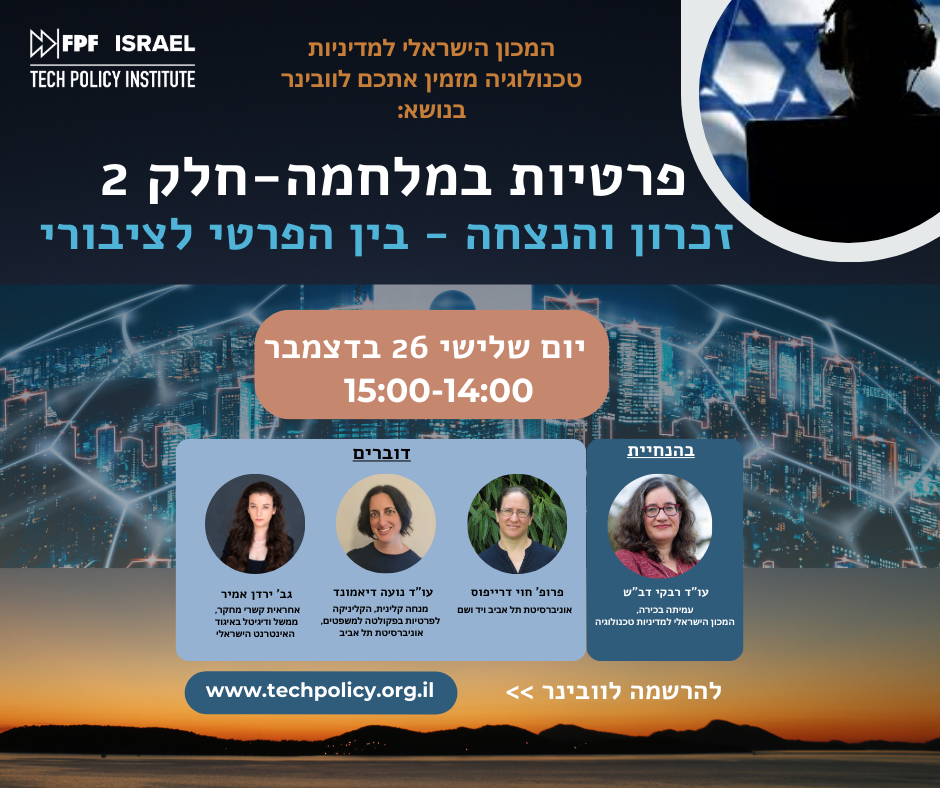
Second Webinar: Memory and Commemorative Aspects
Background
In late 2023, Future Privacy Forum’s Israel Tech Policy Institute held two webinars examining aspects of privacy at wartime.
This post is a review of the second session.
In the present information age, we leave many digital traces behind us – this is part of our daily lives. Even extreme events such as October 7 leave multiple digital traces from a variety of sources – as detailed as they are shocking. In the second webinar, we focused on the dilemmas of privacy vs. the desire to remember and commemorate. We sought to examine and offer practical solutions that would help strike the delicate balance between the personal and national need to document the event as a whole, as well as private individuals within it, and the need to protect people’s privacy.
What follows is a summary of the main points. See below for the full conversation links to presentations.
The series is facilitated by Adv. Rivki Dvash, a senior fellow of the FPF Israeli Tech Policy Institute.
Memory for Perpetuity
Prof. Havi Dreifuss, Department of Jewish History, Tel Aviv University, Head of the Center for Research on the Holocaust in Poland, Yad Vashem International Institute of Holocaust Research.
Link to presentation.
I will discuss how historians cope with the challenge of preserving and perpetuating the memory of traumatic events. Different historians make different decisions. In making them, they are guided, beyond the study of history, by the need to respect the victims and the need to find ways to mediate difficult content to the public—an issue that is, of course, highly relevant to recent events.
For example, my last book dealt with the final months of the Warsaw Ghetto. I wanted to focus on the Jewish public during the uprising, rather than on the uprising itself or the fighters involved, the story of those last remaining 50,000 Jews is horrible. Some were burned alive; others were executed with extreme violence.
When I started writing, it was clear to me I had to talk about the violence, because it was part of the story of the suppression of the uprising. I encountered very difficult testimonies and had to consider how to integrate them into my book in a way that would not deter or offend readers. For example, part of the story of the Warsaw Ghetto is that people were trapped in houses that were ignited and burned alive, and there were highly detailed descriptions of that event. These testimonies were difficult to read even before October 7, but now I must consider who may be exposed to them and how this might affect them. Should I present those descriptions? They are a very important part of the story – how can they be told?
I decided to provide a general description in the main text and present the entire testimony in the footnotes. The same was done with a testimony presented in the webinar presentation that described in detail how a person found 60 bodies, including those of children known to him, as well as with testimony about a horrific rape. Some said this solution was inappropriate because the eye naturally wanders down to fully read the testimony. Even in retrospect, I am unsure whether I made the right decision.
Another solution proposed was to place all the difficult testimonies in an appendix at the end of the book. However, I feared this would become an unreadable appendix of horrors and decided not to adopt this solution.
The dilemma was related not only to textual sources, but also to visual ones. There is a sequence of photos – I’ll talk only about the first. In the photo, we see a group of Jews taken out of their shelter. What happened then is that the men and women were undressed, and the women were subjected to an intimate, very brutal search – and everything was photographed. When I started writing, it was clear to me that I had to include one of the photos: in it, you can see a young woman undergoing this horrible search – and it’s a very powerful photo. Only in the last stages of production, and after a thorough discussion with colleagues from Yad Vashem, I decided to protect the woman’s privacy and describe the scene in words, and to refer the readers to the photo’s archival source.
The reason for that was my assumption that we are all prone to error. Had the photo been included in the book and this had been considered a mistake – then this is a terrible mistake: that miserable woman would have been exposed to the eyes of so many people. On the other hand, had the mistake been in the other direction, and it was needed to include the photo, and this was not done; this is a mistake one can live with. One of the criticisms against that decision was that this woman remained “buried” in the archive, with nobody to see her or know about her fate because a picture is stronger than a thousand words. I believe the decision here is far from straightforward; rather, it reflects some of the dilemmas historians deal with.
Other approaches to anonymization exist, such as using an acronym or pseudonym for the people we refer to.
When discussing the human dignity of the victims, matters become more difficult when dealing with a small group. Even if the victim’s name is not disclosed, the people in the small community will always know who he was. For example, when writing a book (still in progress) on Ultra-Orthodox Jews in the Holocaust) a relatively small and closed community), there is a description of terrible violence and torture and physical, psychological, and sexual humiliation of both Ultra-Orthodox and non-Ultra-Orthodox leaders that shatters and paralyzes the community and may explain its conduct later. So obviously, we need to tell the story, but on the other hand, we’re talking about the rabbi of Community A and the cantor of Community B – we know who they are, and they have a family and may have living descendants. So how do I tell the story without shaming that person? What do we do with the visual documentation? The visual documentation is part of the humiliation, and making it public makes us accomplices – but the story itself is important.
Now, in the aftermath of October 7, we find ourselves facing the same quandary. If we tell the story, we pay a price, but we can’t not tell the story, because it matters so much. There are no good answers. I can only share the dilemmas faced by historians.
Following October 7, together with the aspect of the victims’ dignity, the question of mediation arises. People who have known the ghetto have no need for accurate visual or verbal descriptions. Metaphors are enough for them to realize the extent of the horror. Before October 7, I thought we must talk very concretely about the events of the Holocaust, that we need to explain what it means to be burned alive and be precise about it. And then October 7 happened. What do we do with this now? When facing the public, how can we tell which terrible events have become etched in their minds? The information is so rich, clear, and visual. If information is revealed about something concrete that happened, it is easy to determine the victim’s identity. How do we mediate this when we’re all still deep within that crisis?
When it comes to the Holocaust when mediating with the younger generation, they used to say things like, have no fear; it happened long ago and in a different reality, when the Jewish people had no state of their own. Obviously, October 7 is not the Holocaust, and Hamas are not the Nazis, but we’re still in a deep crisis.
Some of the questions raised also referred to the museology and archiving of the Holocaust and how they can trigger readers or visitors, particularly at this time. For example, those who visited the Holocaust Museum in Washington know that when the contents on display there are very graphic, they are located behind some kind of barrier, and you have to bend and make an effort to see them. Will we still display exhibits from the Holocaust in the same way, or should we be more careful because of the new triggers created after October 7?
Part of coping with these dilemmas is discussing them in the way we have done in this webinar, hoping this would help scholars and practitioners mediate these difficult materials in the future.
The Challenges of Documentation and Preservation
Adv. Noa Diamond, clinical legal instructor, Privacy Clinic, Buchmann Faculty of Law, Tel Aviv University.
Link to presentation.
October 7 was followed by a tremendous awakening of civil society, among other things, due to the governmental void. The civil initiatives and projects dealt with a very wide range of issues. As they were being established and during their activity, extensive and highly sensitive information was gathered—sometimes of the kind that is normally held by the state rather than by private entities.
Following queries we received on issues of privacy and copyright, Prof. Birnhack of Tel Aviv University summoned a group of legal experts – currently, thirty members – who have provided preliminary counseling in these areas to NGOs and private initiatives.
Most initiatives needed help in addressing issues of privacy and thinking about their privacy design, and formulating relevant documents for their website or app. We soon identified a specific and unique type of projects – documentary projects, which required a different approach since they involved unique privacy and copyright issues. These projects started appearing shortly after October 7, and today there are several dozens of them. Some of them merged into a central forum, which serves as a hub for joint thinking and collaboration. Today, there is talk about regulation of the documentary efforts by the state, but we will focus on private projects.
The documenters hail from various professions: documentarians, historians, archivists, researchers, legal scholars, and therapists. The goals and methods of documentation are just as diverse: documentation for historical research, artistic documentation, and documentation for commemoration or propaganda purposes, to be made available for public use. The objects of documentation are likewise diverse: survivors of the Re’im (Nova) music festival, evacuees from the communities bordering Gaza, families of the deceased and hostages, soldiers, police officers, and members of the Disaster Victim Identification organization. The materials are rich and varied. Some have already been broadcast in the media or disseminated on social media, and some are new. They include filmed or recorded interviews, WhatsApp correspondences, children’s drawings, and self-films. Some of the documenters intend to share their materials with the public, and some collect them to preserve the memory and historical documentation without intending to share them publicly, at least not right now.
As opposed to the historical documentation we discussed in the previous section (Prof. Dreifuss presentation), these are very recent events that are highly traumatic—the people documented are often still struggling with them. Moreover, the event is still ongoing, and that, too, needs to be considered.
The first important issue raised was consent. Consent is more important in this than in other privacy contexts, where it is also relevant, of course. This is because, in many cases dealt with by the documenters, the person being documented is experiencing a loss of control as a result of the complete trampling of the victims’ human dignity. During the documentary work, it is important to help these subjects – as much as possible – regain control of their selves, their information, and their story. Control over where information is going and who is exposed to the materials.
The Privacy Protection Law provides protections related to situations of lack of consent. However, we recommended that the documentation projects prefer consent rather than rely on those protections. We recommended they apply a moral heuristic by placing themselves in the subjects’ “shoes”, and then think about the right thing to do. We’re talking about highly sensitive issues and very difficult personal moments, including stories about severe sexual assaults. While the subjects often want to remain anonymous, this can clash with the documenters’ desire for accurate documentation. It is therefore important to enable flexible anonymity, that is, to enable people to choose when and where they want to remain anonymous without being pressured to disclose details they don’t want to.
Another important issue is WhatsApp chats – one of the major source materials for many documentation projects. The law allows using these correspondences when one party consents. Do we want one of the correspondents to be able to share WhatsApp correspondences with a large group without broader consent? We recommend trying to obtain broad and detailed consent from as many group members as possible.
Two issues discussed in brief:
One challenge in advising the documentation projects was “privacy literacy”. Although the project leaders had a healthy intuition regarding cases where privacy issues arose, we needed to train those who collected the information and obtained consent and highlight the importance of obtaining the subjects’ consent. On the one hand, it was important for us to be precise, legally speaking, and on the other hand, we tried to avoid legalese, which could be very tiresome and cause users to neglect principles of privacy protection.
Given the wide variety of project types, materials, subjects, and issues, as presented above, we came up with flexible solutions to enable each project to find and adapt solutions for its needs. In addition, we tried to predict future developments because the projects currently use various materials for uses currently defined, but these uses may change in the future, and people may want to use the materials for alternative purposes – this, too, needs to be considered right now.
Following a question from the audience about documentation in the public spaces of the affected communities, which include the documentation of destroyed houses and sometimes private items visible among the ruins, you should note that the Privacy Protection Law distinguishes between photography in the private and public domain. To answer the question, the specific case needs to be examined. The Supreme Court has already ruled that when deciding the question of whether a domain is private or public, the context is highly relevant. Therefore, even if we are in a public space, but the camera captures a private scene, we must protect its privacy.
The presentation includes a website link summarizing the solutions for documentation projects. A document summarizes the relevant legal principles. We also provide modular consent forms for different stages and parts of documentary projects.
Platforms as Memory Capsules
Yarden Amir, Academic Relations and Digital Outreach Specialist, Israel Internet Association (ISOC-IL).
The presentation includes links to Amir’s manual and additional information from the Israel Internet Association.
The webinar is held at a time when we’re all required to cope with a complex emotional and practical reality. The challenges we now face are not completely new to our private and social space but are now at the center of attention, particularly due to the events’ suddenness, intensity, and multiplicity.
These issues have arisen from the moment we began to be present and gather information online, and the Internet Association is active in promoting research studies and sharing information with the public through manuals and guideline summaries regarding this issue.
On October 7, however, many communities and families in Israel suddenly had to cope with unexpected loss. Realizing that they would need concrete and available information, we decided to create a practical manual based on in-depth research so that whoever needed that knowledge could access it. We understand that as they cope with deep sorrow, those communities and families are also required to perform certain actions involving pain, particularly when it comes to managing digital memories.
When discussing the digital age and the internet, we tend to treat the distinction between digital and physical space too dichotomously. We treat them as separate spaces, whereas their boundaries are blurred in practice. In practice, our identity exists in both spaces almost indistinguishably. This “philosophical” introduction is designed to lay the ground for the understanding or claim that while our digital presence uses technology and is accumulated in cyberspace, it is an integral part of who we are today as social beings in the 21st century.
Our online presence enables us to gather huge amounts of information. The number of online services we harness for our daily needs is tremendous. With that in mind, we need to realize that in the context of the present catastrophe, many victims – particularly young adults, for whom the web is one of the main spaces where their identity is shaped and articulated – have left behind them a trace of information and memories, accessible and manageable by tech companies.
In certain cases where the information is accessible, the question of privacy becomes critical. On the one hand, those who have lost their loved ones feel the need to access the information and gather all the bits and pieces left behind, whether for private mourning or for community commemoration. On the other hand, we have the question of the consent and the will of a person no longer with us.
We need to understand something about the basic concepts central to this discussion and the various options available at the platform level. Whereas in the past, personal objects and items of someone we have lost, such as albums or letters, could be used by the mourning community to commemorate them, in the digital age, they have been converted into code: photo albums have become files stored in computers, hovering in clouds and saved in social media, and postcards and letters have been replaced by virtual chats.
So how can we characterize the information we accumulate in cyberspace? We can use expressions such as digital remains, digital heritage, digital estate, or digital assets. These terms appear to overlap, but each has its own connotations and premises. For example, terms such as “assets” or “estate” are informed by a property perspective, assuming the information is inheritable. In their recent study on the fate of personal data after death (2023), Birnhack and Mors explain that this assumption is too broad and, therefore, decided to call those digital remains “digital memories” – the wealth of information, profiles, photos, and files we store in the various platforms of cyberspace.
We need to be aware of the policies of the various platforms, understand their differences, and understand the various functions they enable. Since the use of digital memories is not regulated in Israeli law, we are left at the mercy of the platforms, particularly when handling information about us post-mortem.
Significant differences exist between the platforms (see presentation for their tabulation). All enable to erase accounts. To erase all contents, including the username, you must contact the company directly and usually present a death certificate or other proof. Some platforms also enable manual erasure or erasure by a legacy contact. Legacy contact is an important term you need to be familiar with in the context of digital memory management. A legacy contact is a designated individual who is assigned by the used responsible for the account of the deceased. This option is currently available only in part of the platforms. Meta (Facebook) was the first to allow it, followed by Apple. The designation of a legacy contact is not an emotionally convenient or pleasant action, but it can help us – and mainly our relatives – to manage our virtual information post-mortem.
Unlike social media platforms, Microsoft does not provide an interface for appointing a legacy contact but allows requests to remove accounts or obtain access in the case of death through legal channels only. Otherwise, access to a Microsoft account will be possible only if we know the passwords of the deceased. If Microsoft is not contacted and the account remains dormant for two years, after which the company will shut down the account itself. This policy of closing inactive accounts is common.
X (Twitter) does not enable external account management or appointing a legacy or commemoration contact. According to the platform’s current policy, inactivity for thirty days leads to the erasure of the account, loss of username, and blocking all access to the account. This approach is a bit unusual.
The function of memorializing an account exists in some social media platforms, most prominently Instagram, Facebook, and LinkedIn, that enable to turn our profile into a memorialized one where family and friends can share memories of the deceased. Technically, they will add a sign to the username to indicate that this is a memorialized account. The platform will also treat the profile differently. For example, it will not offer it as an option for adding a new friend (e.g., “People You May Know”) and will not provide birthday reminders. Thus, the account turns into a kind of space where you can cherish the memory of the deceased.
These are some of the ways platforms have suggested to deal with the accounts of the deceased. However, the more difficult dilemma is where we have direct access to the accounts (thanks to access to the device or familiarity with the passwords to the networks of the deceased). Do we have the right to use these accounts and the information in them? What do we need to do in order to respect the privacy of those who have not decided that question themselves?
Birnhack and Mors’s studies have revealed fascinating insights. One issue that has preoccupied privacy researchers is the so-called “privacy paradox”. People state they care about privacy, but in practice, their behavior suggests they do not: they give away personal information easily, do not protect their private data, and more. Since the issue of digital memories embodies questions of post-mortem privacy, they also sought to examine whether this paradox outlives us. In other words, are users’ statements about the importance of privacy for them even after death accompanied by relevant actions, such as protecting accounts using a strong password or sharing passwords with family members? As the presentation reveals, they showed that the privacy paradox is reversed after death. This means that people who were interested in enabling access to their accounts to their loved ones have failed to take the actions needed to enable such access, in practical terms, their wishes might not be realized since their accounts would remain locked and their information out of reach.
One last issue is the principle of continuity. This is, in fact, the answer to the question of what needs to remain private or what should become public. Which information can we access, morally speaking? The participants in Birnhack and Mors’s study indicated that what used to be private or public should remain private or public.
If a person’s control over their privacy is important, we would like to maintain it even after death. In Birnhack’s (2016) “Circles of Privacy”, he describes privacy as a series of concentric circles of disclosures based on the social context: some information will be shared with a loved one, other information will be shared with our physician or insurance company, but not with a government authority. Skipping from one circle to another against the individual’s wishes is defined as a violation of privacy.
The privacy of the deceased is not regulated in legislation. Therefore, we approach it from a moral perspective that emphasizes the dignity of the dead. Therefore, I will leave the question of retaining the control of privacy even after a person’s death as an open one.
Privacy at war – summary of first webinar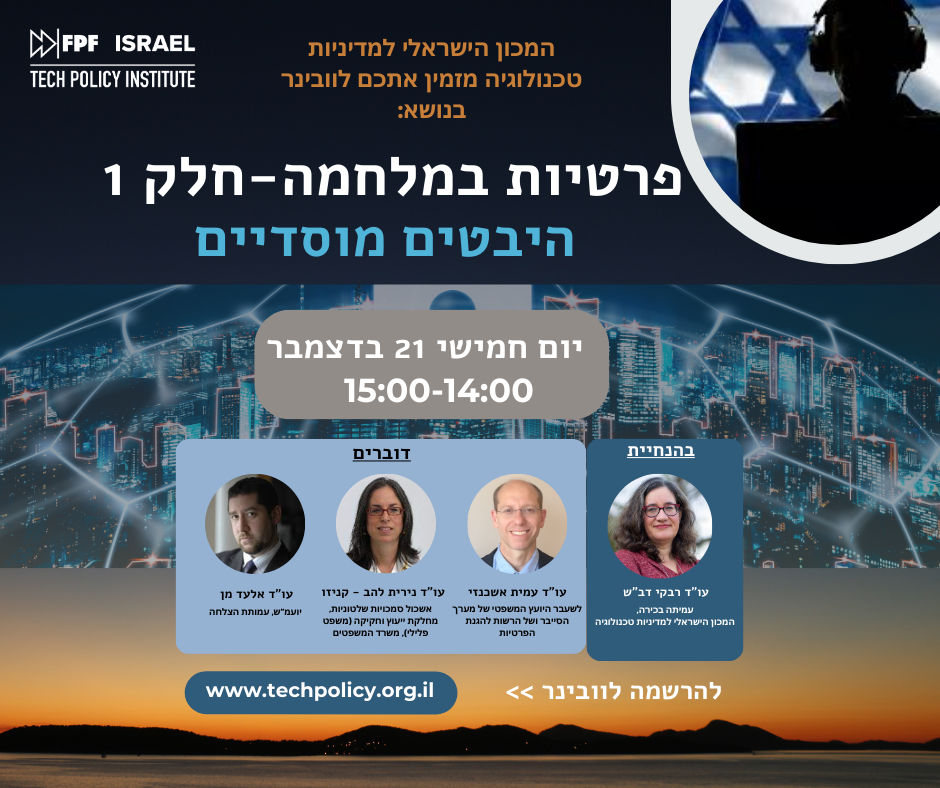
First Webinar: Administrative Aspects
Background
In late 2023, Future of Privacy Forum’s Israel Tech Policy Institute, held two webinars looking into aspects of privacy at wartime.
It appears that as much as many believe it to be an unnecessary luxury in the digital age, privacy is being neglected even more during war time. Like the proverbial muses, it seems that when the cannons roar, privacy is silent.
It is clear that wartime in Israel involves dilemmas and needs that can clash with privacy and data protection. For example, the desire to share videos for commemoration or public relations purposes, or for community-based organizations to deal with emergencies or support certain populations requires obtaining personal information. On the administrative level as well, the challenges we have faced upon the outbreak of the war can be met more efficiently by using data. For example, the need to identify a huge number of corpses within a short time, and cyber-attacks on larger scales than in the past, and with potential critical implications during wartime all create exigent circumstances that may be in tension with data protection.
We have therefore decided to devote some time to several questions that have preoccupied the Israeli public of late. In the first webinar, we focus on the administrative aspects of the dilemmas, and the second webinar is devoted to individual aspects, with emphasis on our personal need for memory and commemoration.
What follows is a summary of the main points. See below for the full conversation and a link to the video (in Hebrew).
The series is facilitated by Adv. Rivki Dvash, a senior fellow in the Israeli Tech Policy Instituter.
Cyber Security Risks
Amit Ashkenazi, adv, law and policy consultant (cyber, ai, data protection), former legal advisor at the Israel National Cyber Directorate and the Israel Privacy Protection Authority.
First’ I’d like to distinguish conceptually between violating an individual’s privacy and privacy in its technological context, which is the subject of this discussion. We’re discussing the principles of using technology in order to avoid privacy violation.
Another relevant and closely related area is information security and cyber defense. This area deals with the way we use technology and information systems. This usage exposes us to risks produced by the technologies. We consume technology differently from the way we consume healthcare, for example, because technology in most cases does not require licensing or pretesting prior to launching, and its defects are often discovered only during use. People with malicious purposes can use these faults to our disadvantage.
With its information security regulations, the consent requirement, the principle of purpose limitation, etc., the Privacy Protection Law tries to minimize the risk.
Two pieces of legislation have recently been promulgated in the cyber area – Temporary Law on Handling Severe Cyberattacks in the Digital and Storage Services Sector (“Iron Swords”), 5774-2023 [hereafter, Cyber Law] and the Authorization Law for Penetrating Computer Material Used for Operating a Stationary Camera (“Iron Swords”), 5774-2023 [hereafter, Camera Law].
Cyber legislation is designed to incentivize service providers to show greater responsibility. This is always required, but in wartime, when cyberattacks also increase, this may be critical. We have seen severe disruption in Ukraine due to cyber warfare and lack of protection.
Here, we are exposed to a complex situation involving cyber defense and national security because unlike physical security in public space, the organization responsible for cyber protection is the one that has installed the technology to begin with, and in fact, if it doesn’t follow the rules, it would be very difficult for any national public administration body to act in its stead. Therefore, we see a trend – worldwide and in Israel – of imposing increasing legal obligations on organizations to deal with cybersecurity, among other thing to prevent harm to third parties.
The working assumption of the Camera Law is that there’s a certain place where a camera is installed, which is hacked, unbeknownst to the owner, or without the owner being able to handle the hack. At the moment, we lack the legal tools to protect ourselves against such an event, which could be critical in an emergency. After October 7, we need to consider the possibility that this could be a preliminary move leading to terrible things.
In this case, the law authorizes the Commander of the Cyber Defense Division to authorize soldiers to handle the failure and risk, without a court order and without being required to notify the camera owner. This is a highly significant precedent in the state’s ability to access private computers. Note that the law is highly restrictive with regard to what may be done after penetrating the computer: no private information can be collected or used.
In the US, the FBI accessed computers remotely in order to address vulnerabilities out of fear for the broad public interest and the understanding that it is impossible to reach out to every victim in order to deal with the bugs. But there, this was done subject to a legal order authorizing the agency to do highly selective actions. the order was granted based on expert opinion, and the FBI was required to notify the computer owners as much as possible.
To conclude, we see the complexity in the need to block cyberattacks and prevent the possibility of misusing poorly installed cameras, and the dilemmas related to the very authorization to perform these actions.
Regarding the Cyber Law, various countries already have regulations in place that apply to suppliers in peacetime as well, because they’re responsible for protecting their customers. Here, we have a preliminary requirement, prior to exercising the authority. The requirement is for a severe cyberattack to take place. A theoretical prediction is not enough.
This begs the question, why do we need protective legislation only after the risk has already materialized? In previous versions of cyber legislation, there was a broader range of tools that also addressed the obligation to prevent risk. For example, we thought of cyber security guidelines and standards to be applied in the customs when importing technological products, or that whoever buys a security camera would be given a form with guidelines on how to change the camera’s password and recommendations for downloads that would make it more secure. In other words, if we want to provide more systematic protection, we don’t have to start with these dramatic legislative tools.
The Immediate Need for Information to Identify the Dead
Adv. Nirit Lahav-Kanizo, Government Authorities Cluster, office of legal counsel and legislative affairs (Criminal Law), Ministry of Justice.
Let me start with a trigger warning: the subject under discussion is not easy to digest. Note also that some of the details have to do with activities of security or intelligence agencies, so I will present the reality as we’ve experienced it subject to these limitations.
On the evening of Saturday 7, the situation was that several hundreds of bodies would have to be identified by the police within a short time, and legislative amendment were required to that end. Beyond the understandable need to identify the bodies for the families, we needed to be very clear on which bodies belonged to terrorists, and how the number and identity of hostages could be estimated, given the need to make strategic and operational decisions about Israel’s political and military response – again, within a tight schedule.
The police routinely identifies bodies and locates John Dos, but the reason it needed immediate legislative amendments was the sheer scope of the events – hundreds of casualties, at a scope completely unknown to date, in an event that also involved hostages taken beyond the border, in wartime.
Already by Saturday evening, we knew we had corpses in highly severe conditions (burnt bodies, mutilated body parts, etc.), and that identification would be very difficult. In the background, there were the very large amounts, and the evacuation difficulties at first, while rockets were still being shot and terrorists still roaming the area. Some of the bodies were collected by civilians and members of the Disaster Victim Identification organization, so that we didn’t always know to pinpoint the body’s original location, thereby helping the police to start identifying it.
The military and security organizations are able to identify their soldiers and employees because they are prepared for these situations, but there is no such preparedness when it comes to civilians.
The emergency regulations that allowed us to cross-reference information from the national Biometric Database were promulgated under the assumption that we may find ourselves facing multiple arenas with similar scenarios.
So what are the amendments we have promoted to meet all these needs?
First, we enabled the Israel Police, the IDF, the ISA (Shabak) and the Mossad to obtain facial photographs and fingerprints from the Ministry of the Interior’s Biometric Database in order to identify bodies and locate missing persons – only for this restricted purpose. When it comes to fingerprints, we have highly advanced technology that can significantly reduce the uncertainty regarding the identity of the deceased within a very short timeframe. Note that the database was not shared in its entirety, nor in parts. The information was received in two configurations: facial photos and fingerprints of the deceased and missing persons, and the transfer of fingerprints of bodies to the [National Biometric Database] Authority, which compared it with the database to obtain identification results regarding each. In other words, we are talking about highly restricted information.
This authority is not new. The option is available also in the current version of the Inclusion of Biometric Means of Identification and Biometric Identification Data in Identity Documents and in an Information Database Law, 5777-2009. The police can also obtain that information from the database by court order for the purpose of identifying and locating missing persons, and the ISA and Mossad can also receive that information for their purposes.
The existing legal provisions could not be activated however, since this required regulations that had not yet been approved. Hence the need for an alternative option. With regard to the IDF, which is not mentioned in the law, this is indeed an innovation, but this is required given the IDF’s skills and capabilities in locating missing persons, required at this time also with regard to civilians as well as given the military context of the abduction. In the end, we waived the requirement for a court order.
The second authority we provided for was to demand information and documents provided to the police on a very broad basis – but strictly for the purpose of identifying the deceased and locating missing persons.
Perhaps the most worrisome aspect from the public perspective was the government’s decision to go back to saving fingerprints in a database and keep the prints that still exist in it, which is a return to the situation before 2017, when it was decided to delete the database. As also stated in the Knesset, what is at stake here is a future need to be able to learn lessons and change the arrangements determined in 2017. There are also general thoughts about the appropriateness of that decision, regardless of the purpose of identifying bodies and missing persons, given technological aspects not met by facial photos. At the moment, the temporary order is to prevent fingerprints from being deleted from the database for one year, with the option to extend it for an additional year, but only for the restricted purposes provided for in the legislation.
To minimize the violation of privacy, protective mechanisms have been integrated. The organizations do not have access to the database. Oversight mechanisms are also in place, with procedures requiring the agencies receiving the information to protect it and use it only for the purpose provided for in the law. There are instructions to erase unnecessary information. The agencies are also aware that this is sensitive information, and that the biometric database is to be used only in the lack of any alternatives.
Dilemmas of Government Public Relations and the Public’s Right to Know
Adv. Elad Man Chief Legal Counsel to Hatzlaha – Promoting a Fair Society, media and communication regulation scholar, former member of the Press Council Presidency.
Our starting point is the fact that we have a large amount of documentary materials, many in audio, that powerfully visualizes the events of October 7th. These materials have an aspect of violating privacy. Therefore, we need to examine the purpose of these materials and whether that purpose prevails over the right to privacy.
Some of the materials are related to people who are no longer alive, and others to people who cannot express their will (hostages) — so consent is irrelevant. These situations become even more traumatic because of what is documented. Some of the subjects are minors, and some footage reveals traumatic and graphic events to which one would not necessarily consent to broadcast.
Beyond promoting the Israeli cause, these materials must be presented as evidence in international legal and quasi-legal forums to convince them of the need to act. Some of the videos are used for propaganda campaigns—both explicit and implicit—directed also at Israeli citizens. Such usage may be considered more problematic, particularly if it is implicit and if, given its very nature, official agencies would not want anyone to know that it was used either fully or partially for their purposes.
Beyond these official uses, we also need to ask journalistic questions, such as whether it is professionally and ethically justified to violate values protected by legislation that protects privacy, for example, or legislation concerning the protection of minors or crime victims, which forbids the publication of certain materials in specific cases. Is it right to make an exception? Is it legally permissible to shift the balance we have known until now?
In the treatment of these materials by the media and government bodies, we see a range of solutions and steps taken, not only out of privacy considerations. Sometimes, they are guided by other factors, such as fear of affecting morale or fear of public response, despite the material’s propaganda value. For example, it was decided not to broadcast hostage videos disseminated by Hamas, as well as other videos by Hamas, although they are accessible on foreign channels and social media. The solution was to report on the video without broadcasting it.
The idea is to align the policy with the families’ interests. But in some cases, the family wanted to air the video, and the media thought this was ethically wrong. Another solution was to play a video edited by the IDF to a limited audience of foreign journalists and diplomats. Later on, it was also shown to members of the Knesset and senior officials abroad, Hollywood influencers, etc. The spectrum of viewers broadened, but the raw materials were still not broadcast to the public, and no authorization was given to take snapshots from the video. This is also a situation unique to the extreme circumstances we have found ourselves in.
As opposed to privacy violation, there is a need that goes beyond public relations – the paramount need to initiate moves to save the lives of Israeli hostages Here, matters are highly situation-dependent, and we can think of all kinds of dilemmas. For example, had there been documentation of Israelis shooting hostages? This is a complex question not only in terms of privacy. There is also a public interest in revealing what happened there, but this is highly sensitive at the moment.
There is also a blind spot that must be raised, as awkward as it may be to do so, which is protecting the privacy of the other side. We have seen photos of the mass arrests of those described as civilian Hamas activists or terrorists, but eventually, most of them have been released. The IDF itself has learned lessons from these events.
We must understand that there is no single solution for all cases. There are various solutions, and I’m not certain whether, should one of these cases find its way to court, the boundaries could be clearly drawn. There are various perimeters of reasonable conduct. This only illustrates the complexity of these times and the tension between privacy and other purposes and benefits.
Link to the video.
מדיניות AI בישראל
מבוא
נושא הבינה המלאכותית (AI) זוכה לבחינה נרחבת בתחום אסדרת הטכנולוגיה. היכולות של מערכות ה-AI מציבים אתגרים חדשים ומורכבים ובהם הצורך לשמר על נטרליות, שקיפות אלגוריתמית תוך הגנה על הזכות לפרטיות וזכויות קנייניות כגון זכויות יוצרים. ב-17 בדצמבר יצאה הודעה מטעם משרד החדשנות, המדע והטכנולוגיה בישראל, על קביעת מדיניות בתחום הבינה המלאכותית. במסמך זה נסקור את הרקע לאסדרת תחום ה-AI בישראל ואת העקרונות שקובע המסמך החדש. בסיכום המסמך נעיר בקצרה על היתרונות והחסרונות ממדיניות המוצעת.
1 – החלטות ממשלה – בינה מלאכותית ((AI
1.1 החלטת ממשלה 212 (אוגוסט 2021)
תוכן ההחלטה
ב-1 באוגוסט 2021, שרת החדשנות, המדע והטכנולוגיה, מונתה על ידי ממשלת ישראל כאחראית להובלת מדיניות ממשלת ישראל בתחום הבינה המלאכותית (החלטה מס’ 212). בין היתר נדרשה השרה דאז להקים צוות עבודה שיגיש בתוך חצי שנה את המלצותיו בנושאי “רגולציה, מדיניות מידע ונתונים, אתיקה, שיתוף פעולה בין-לאומי אזרחי והטמעה במגזר הציבורי האזרחי … ולגבש תכנית לאומית בהתאם, תוך התחשבות בעקרונות משפטיים ואתיים מקובלים בעולם…”.
כמן כן נקבע, כי יש לפעול ליישם המלצות קודמות שהוגשו לממשלה על ידי פורום לתשתיות לאומיות למחקר ולפיתוח (להלן – פורום תל”מ) ובהם:
לשם יישום המתווה הוחלט על הקצאת 550 מיליון ש”ח מתקציב המדינה בהחלטת הממשלה שיוקצה למשרדים הרלוונטים, וזאת כפעימה ראשונה משתי פעימות מתוכננות.
יוער כי דו”חות קודמים שהוגשו בשלהי שנת 2020, המליצו על השקעה גבוהה משמעותית בתחום: דו”ח המיזם הלאומי למערכות נבונות בנושא אתיקה ורגולציה של בינה מלאכותית (עברית, אנגלית), שהובילה אוניברסיטת תל אביב בהשתתפות מאות מומחים בתחום, המליצה על תקציב של 10 מיליארד ש”ח למשך 5 שנים והקמת מנהלת לאומית ייעודית לנושא במשרד ראש הממשלה; 1 ודו”ח פורום תל”מ שהוזכר לעיל, המליץ על הקצאת 5.26 מיליארד ש”ח שיוקצו ישירות לגופים הרלוונטיים שיעסקו בתחום. 2
יישום
ביולי 2022 פורסם כי ישראל גיבשה “תוכנית לאומית לבינה מלאכותית”, אולם תוכנית זו לא פורסמה לציבור באופן מלא. עוד קודם לכן פורסם מסמך מקצועי של משרד המשפטים בנושא “עקרונות מדיניות, רגולציה ואתיקה בתחום הבינה המלאכותית” (אין גרסה באנגלית). 3 על בסיס מסמך זה, פרסמה שרת החדשנות, המדע והטכנולוגיה, קול קורא לציבור (אין נוסח באנגלית) להעיר על ההמלצות לקביעת מדיניות בתחום ה-AI (אוקטובר 2022). במסמך צוין כי נכון למועד זה, תפיסת המדיניות היא שאין צורך בקידום חקיקה ייעודית לתחום הבינה המלאכותית, אך ככל שהתחום יתפתח ויתבסס, הצורך בחקיקה ייבחן שנית.
יצויין כי במעקב אחר יישום החלטת ממשלה 212, כפי שמופיעה במשרד ראש הממשלה, התקצוב ליישום ההחלטה טרם הוקצה.
1.2 החלטת ממשלה 173 (פברואר 2023)
ב-24 בפברואר 2023, התקבלה החלטת ממשלה 173 שהיא המשכה של החלטה 212 והחלטות נוספות, ועניינה “חיזוק המובילות הטכנולוגית של ישראל”. בהחלטה זו, אומצה תוכנית לאומית לבינה מלאכותית שהציעה שלושה עקרונות –
לצורך יישום המתווה נקבע כי יוקצה תקציב כהרשאה להתחייבות שלא יעלה על 500 מיליון ש”ח למימוש בין השנים 2023 – 2026.
כמו כן, הוחלט כי משרד החדשנות, המדע והטכנולוגיה, יקים “מוקד ידע ותיאום ממשלתי בתחומי הבינה המלאכותית” לקדם נושאים שנקבעו בסעיף 6(א) של החלטה 212 (מדיניות הממשלה בתחום הבינה המלאכותית בנושאי רגולציה, מדיניות מידע ונתונים, אתיקה, שיתוף פעולה בין-לאומי אזרחי והטמעה במגזר הציבורי האזרחי, וגיבוש תכנית לאומית).
לעת עתה עברה החלטת ממשלה (החלטה מספר 1161 מיום 22 בדצמבר 2023) למנות ראש אגף בכיר בתחום הבינה המלאכותית בפטור ממכרז, המעיד על בכירותו של ראש האגף כמו גם על היותו של המכרז בעל יכולת להיות מינוי פוליטי. נכון למועד כתיבת סקירה זו, לא פורסמה קריאה להגשת מועמדות למשרה.
2 – עקרונות מדיניות רגולציה בתחום הבינה המלאכותית שממשלת ישראל קידמה עד כה
בדצמבר 2023, הודיע שר החדשנות, המדע והטכנולוגיה, על אימוץ ההמלצות של עבודת המטה שקודמה על ידי משרדו, משרד המשפטים ורשות החדשנות. המלצות אלו, המופיעים בהרחבה במסמך עקרונות מדיניות רגולציה בתחום הבינה המלאכותית (נוסח בעברית, תרגום תקציר המנהלים באנגלית), העדיפו יצירת מסגרת גמישה של עקרונות לקביעת רגולציה בתחום הבינה המלאכותי, וזאת להבדיל מחקיקה או ממערכת נורמטיבית כופה אחרת. כלומר, במקום סט נורמטיבי מובחן, המסמך נועד להנחות את הרגולטורים השונים בבואם לקבוע הנחיות לשוק עליו הם אמונים ואשר נוגע לתחום הבינה המלאכותית.
2.1 עקרונות כלליים של מדיניות הרגולציה עבור בינה מלאכותית
המסמך מתייחס לקביעת שישה עקרונות מנחים שלפיהם מוצע לקבוע מדיניות בינה מלאכותית (אין זה תקן מחייב אלא תקן מנחה):
2.2 עקרונות אתיים מובילים
לאור העקרונות לקביעת המדיניות, ובהתאמה לעקרונות המוצעים בנושא ב-OECD (בשינויים קלים), ממליצים גורמי המטה לאמץ שישה עקרונות אתיים בתחום הבינה המלאכותית –
יש לציין שחלק מעקרונות אלו דומים יותר להצבת מטרות, במקום לבטא עקרונות אתיים (ראו, למשל, סעיף 1).
2.3 מוקד ידע
ההמלצות שמקדם שר החדשנות, המדע והטכנולוגיה מציעות להקים מרכז ידע ממשלתי לטיפול בחסרונות הפערים שעלולים לנבוע מההמלצה לקיים מדיניות כללית וגמישה, לא מחייבת עבור בינה מלאכותית. תפקידו של מרכז הידע יהיה להיות גוף מתאם בין רגולטורים, מייעץ, מנהל פורומים רלוונטיים, מקדם שיתופי פעולה בינ”ל ועוד.
על מנת להרחיב את נקודת המבט של מוקד הידע, ועל מנת לחזק את השפעתו, מוצע לקבוע כי למרכז הידע תהיה ועדת היגוי מאגפים שונים בממשלה: מנכ”ל משרד החדשנות, המדע והטכנולוגיה (יו”ר הוועדה); מנהל מוקד הידע; המשנה ליועץ המשפטי לממשלה (משפט כלכלי) במשרד המשפטים; הממונה על התקציבים במשרד האוצר; ראש רשות הרגולציה; ראש רשות הגנת ה פרטיות; ראש מערך הדיגיטל הלאומי; ומנכ”ל רשות החדשנות.
2.4 הצעות נוספות
עוד מוצע כי –
3. הערות מסכמות
על אף ההבנה בדבר חשיבות אסדרת תחום הבינה המלאכותית, כפי שעולה מהחלטות הממשלה וממתווה תל”ם, ממשלת ישראל בוחרת לקדם שימוש בכלי רגולציה רכים מאוד. העקרונות שאומצו כוללים המלצות שאינן מחייבות לרגולטורים, ומנוסחים באופן רחב וגמיש.
ניתן להבין החלטה זו גם בהקשר של הקושי של ממשלת ישראל לקדם חקיקה חדשנית במהירות. ראו, למשל, תהליך תיקון חוק הגנת הפרטיות, שמקודם מאז 2011 כטלאים של שכבות של התערבויות צרות במקום קידום גישה מקיפה וקוהרנטית בתחום או הסדרת רשתות חברתיות. .
היתרונות בשימור גמישות כמו זו המוצעת, מובנים בעת עיסוק ברגולציה בתחום חדשני שמתפתח כל הזמן במהירות כמו בינה מלאכותית. ובכל זאת, הם דורשים מאמץ משמעותי בפיתוח הידע הדרוש ליישום יעיל של ההמלצות שהוצעו, יצירת תמריצים חיוביים ליישום הרגולציה הנובעת מכך, יצירת מערכת לשיתוף פעולה, למידת עמיתים ועוד. לשם כך נדרש, כמוצע, מרכז אחד המנהל את התחום.
נכון למועד זה, תהליך איוש מנהל המרכז מצוי בחיתוליו, וטרם הוקצו הסכום המוגדר כנדרש למימון.4
כמו כן, המלצות המדיניות נוגעות להתנהלות המגזר הפרטי בלבד, ולא המגזר הציבורי, אשר לשימוש במערכות מבוססות בינה מלאכותית בו, עשויות להיות השלכות מרחיקות לכת. הטעם לכך, כמפורט במסמך, הוקמה ועדה ממשלתית נפרדת המגבשת את המלצותיה לשירות הציבורי.
על מנת שמסגרת רגולטורית רכה זו תעמוד באתגרים של טכנולוגיה טרנספורמטיבית המתפתחת במהירות, יש צורך לספק את המימון המוצע ולקיים גישה קוהרנטית בהנחיה ובתקנות. היכולות הטכניות המתקדמות של ישראל בתחום הבינה המלאכותית דורשות יישום מנגנוני בטיחות יעילים ועקרונות אתיים חזקים כדי למנוע נזקים הנגרמים מפיתוח ופריסה של כלי בינה מלאכותית. במילים אחרות, בפיתוח טכנולוגיית AI נדרשת מנהיגות בניהולה. על מנת ליהנות מהיתרונות של הרגולציה הרכה המוצעת, יש לפעול לפי המנגנונים המדויקים המוצעים – ממימון, דרך מרכז הידע בינה מלאכותית ומבנים נוספים שנוצרו.
למרות שמסגרת עשויה להיות בת ביצוע בתקופה זו של אי ודאות ושינוי מהיר, היא לא צריכה להיות גישה לטווח ארוך. ככל שכלכלות מובילות ברחבי העולם עוברות לאמץ חקיקה פורמלית, יהיה חשוב לישראל לעקוב מקרוב אחר התפתחויות אלו ולנקוט בגישה חקיקתית שיכולה גם לתמוך במחקר ושירותים חדשניים תוך הבטחת הגנות משפטיות.