
Today’s cities are pervaded by growing networks of connected technologies to generate actionable, often real-time data about themselves and their citizens. Relying on ubiquitous telecommunications technologies to provide connectivity to sensor networks and set actuation devices into operation, smart cities routinely collect information on cities’ air quality, temperature, noise, street and pedestrian traffic, parking capacity, distribution of government services, emergency situations, and crowd sentiments, among other data points.
While some of the data sought by smart cities and smart communities is focused on environmental or non-human factors (e.g., monitoring air pollution, or snowfall, or electrical outages), much of the data will also record and reflect the daily activities of the people living, working, and visiting the city (e.g., monitoring tourist foot traffic, or home energy usage, or homelessness). The more connected a city becomes, the more it will generate a steady stream of data from and about its citizens.
Sensor networks and always-on data flows are already supporting new service models and generating analytics that make modern cities and local communities faster and safer, as well as more sustainable, more livable, and more equitable. At the same time, connected smart city devices raise concerns about individuals’ privacy, autonomy, freedom of choice, and potential discrimination by institutions. As we have previously described, “There is a real risk that, rather than standing as ‘paragons of democracy, [smart cities] could turn into electronic panopticons in which everybody is constantly watched.” Moreover, municipal governments seeking to protect privacy while still implementing smart technologies must navigate highly variable regulatory regimes, complex business relationships with technology vendors, and shifting societal – and community – norms around technology, surveillance, public safety, public resources, openness, efficiency, and equity.
Given these significant and yet competing benefits and risks, and the already rapid adoption of smart city technologies around the globe, the question becomes: How can communities leverage the benefits of a data-rich society while minimizing threats to individuals’ privacy and civil liberties?
Just as there are many methods and metrics to assess a smart city’s livability, sustainability, or effectiveness, so too there are different lenses through which cities can evaluate their privacy preparedness. In this article, we lay out three such perspectives, considering a smart city’s privacy responsibilities in the context of its role as a data steward, as a data platform, and as a government authority. While there are likely many other lenses that could be used to capture a community’s holistic privacy impacts, exploring these three widely tested perspectives can help municipalities better leverage existing privacy tools and safeguards and identify gaps in their existing frameworks.
By considering the deployment of smart city technologies in these three lights, communities will be better prepared to reassure residents of smart cities that their rights will be respected and their data protected.
ITPI’s Omer Tene and co-author Kelsey Finch of the Future of Privacy Forum discuss further in the chapter they have written in the recent Cambridge Handbook of Consumer Privacy. The chapter is available at SSRN here.
Taming The Golem: Challenges of Ethical Algorithmic Decision-Making
Omer Tene and Jules Polonetsky recently published, “Taming The Golem: Challenges of Ethical Algorithmic Decision-Making,” in Volume 19, Issue 1, of the North Carolina Journal of Law and Technology.
The prospect of digital manipulation on major online platforms reached fever pitch in the last election cycle in the United States. Jonathan Zittrain’s concern about “digital gerrymandering” found resonance in reports, which were resoundingly denied by Facebook, of the company’s alleged editing of content to tone down conservative voices. At the start of the last election cycle, critics blasted Facebook for allegedly injecting editorial bias into an apparently neutral content generator: its “Trending Topics” feature. Immediately after the election when the extent of dissemination of “fake news” through social media became known, commentators chastised Facebook for not proactively policing user- generated content to block and remove untrustworthy information. Which one is it then? Should Facebook have employed policy- directed technologies or should its content algorithm have remained policy-neutral?
This article examines the potential for bias and discrimination in automated algorithmic decision-making. As a group of commentators recently asserted, “[t]he accountability mechanisms and legal standards that govern such decision processes have not kept pace with technology.” Yet this article rejects an approach that depicts every algorithmic process as a “black box” that is inevitably plagued by bias and potential injustice. While recognizing that algorithms are man-made artifacts, written and edited by humans in order to code decision-making processes, the article argues that a distinction should be drawn between “policy-neutral algorithms,” which lack an active editorial hand, and “policy-directed algorithms,” which are intentionally framed to further a designer’s policy agenda.
Policy-neutral algorithms could, in some cases, reflect existing societal biases and historical inequities. Companies, in turn, can choose to fix their results through active social engineering. For example, after facing controversy in light of an algorithmic determination to not offer same-day delivery in low-income neighborhoods, Amazon nevertheless recently decided to provide those services in order to pursue an agenda of equal opportunity. Recognizing that its decision-making process, which was based on logistical factors and expected demand, had the effect of facilitating prevailing social inequality, Amazon chose to level the playing field.
Policy-directed algorithms are purposely engineered to correct for apparent bias and discrimination or to advance a predefined policy agenda. In this case, it is essential that companies provide transparency about their active pursuits of editorial policies. For example, if a search engine decides to scrub results clean of opposing viewpoints, it should let users know they are seeing a manicured version of the world. If a service optimizes results for financial motives without alerting users, it risks violating FTC standards for disclosure. So too should service providers consider themselves obligated to prominently disclose important criteria that reflect an unexpected policy agenda. The transparency called for is not one based on revealing source code but rather public accountability about the editorial nature of the algorithm.
The article addresses questions surrounding the boundaries of responsibility for algorithmic fairness and analyzes a series of case studies under the proposed framework.
Infographic: Data and the Connected Car – Version 1.0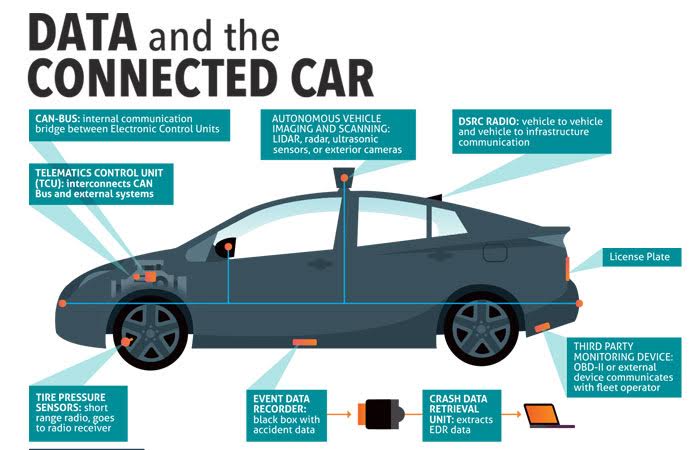
The infographic, “Data and the Connected Car – Version 1.0,” describes the basic data-generating devices and data flows in today’s connected vehicles. The infographic aims to help consumers and businesses alike understand the emerging data ecosystems that power incredible new features—features that can warn drivers of an accident before they see it, or jolt them awake if they fall asleep at the wheel.
Many of these new features are enabled by the collection of new types of data, putting the topic of privacy in connected cars on the agenda of industry, policymakers, and regulators. The benefits of connected vehicle technologies are crucial to addressing the 94% of car accidents that are caused by human error. But we need to foster transparency and communication around consumer data use in order to deploy them responsibly. Conversations between lawmakers, consumers, and businesses need to go beyond the current day and focus on building trustworthy data practices—and communicating them—as vehicles advance.
Written by Lauren Smith
Shedding Light on Smart City Privacy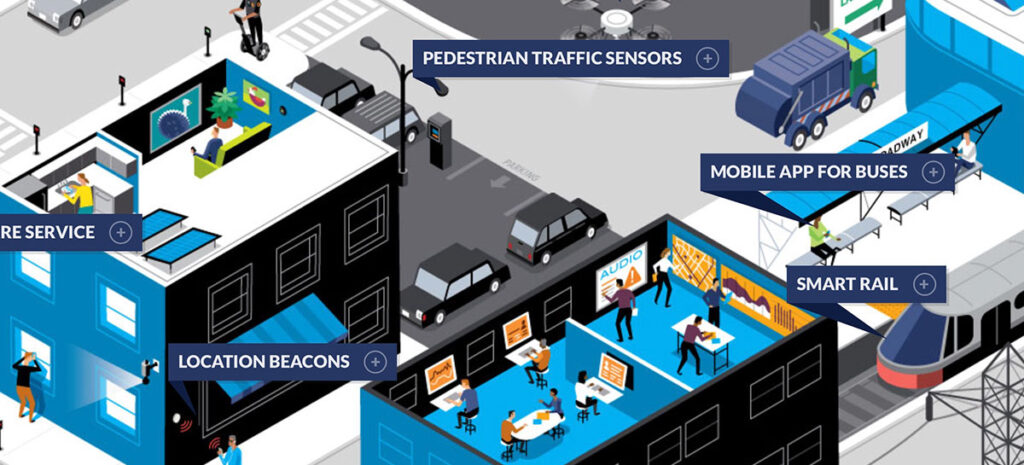
This visual guide “Shedding Light on Smart City Privacy” Is meant to help citizens, companies, and communities understand the technologies at the heart of smart city and smart community projects – and their potential impact on privacy.
Cities and communities generate data through a vast and growing network of connected technologies that power new and innovative services ranging from apps that can help drivers find parking spots to sensors that can improve water quality. Such services improve individual lives and make cities more efficient. While smart city technologies can raise privacy issues, sophisticated data privacy programs can mitigate these concerns while preserving the benefits of cities that are cleaner, faster, safer, more efficient, and more sustainable.
Shedding Light on Smart City Privacy highlights the wide range of connected technologies and services appearing throughout our communities – everything from streetlights that measure air and noise pollution to smart electric grids to buses that re-route based on demand. The visual guide also provides important context to these new technologies and services, allowing visitors to sort technologies and services based on what sectors they might serve, what other technologies enable them, and who within their communities might use or deliver them.
The visual guide also describes some of the top privacy concerns raised by smart city technologies and services, both for individuals and for communities. It describes key tools for mitigating those risks, including robust privacy programs, transparency and consent, de-identification, vendor management, and data minimization.
As cities and communities become more connected, it is critical that they learn to leverage the benefits of a data-rich society while minimizing threats to individual privacy and civil liberties. Our new guide provides a useful tool to help all smart city and community stakeholders hold important discussions and make informed decisions about their privacy policies and practices.
Written by Kelsey Finch
A Visual Guide to Practical Data De-Identification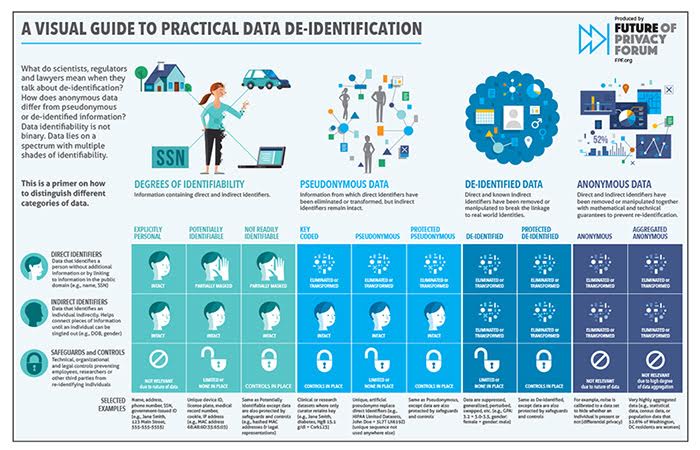
For more than a decade, scholars and policymakers have debated the central notion of identifiability in privacy law. De-identification, the process of removing personally identifiable information from data collected, stored and used by organizations, was once viewed as a silver bullet allowing organizations to reap data benefits while at the same time avoiding risks and legal requirements.
However, the concept of de-identification has come under intense pressure to the point of being discredited by some critics. Computer scientists and mathematicians have come up with a re-identification tit for every de-identification tat. At the same time, organizations around the world necessarily continue to rely on a wide range of technical, administrative and legal measures to reduce the identifiability of personal data to enable critical uses and valuable research while providing protection to individuals’ identity and privacy.
The debate around the contours of the term personally identifiable information, which triggers a set of legal and regulatory protections, continues to rage, with scientists and regulators frequently referring to certain categories of information as “personal” even as businesses and trade groups define them as “de-identified” or “non-personal.”
The stakes in the debate are high. While not foolproof, de-identification techniques unlock value by enabling important public and private research, allowing for the maintenance and use – and, in certain cases, sharing and publication – of valuable information, while mitigating privacy risk.
Download A Visual Guide to Practical Data De-Identification
Written by Kelsey Finch
Welcome to the Metropticon: Protecting Privacy in a Hyperconnected Town
Over half a century ago, Jane Jacobs sparked a revolution in urban planning with her 1961 book The Death and Life of Great American Cities, challenging the first wave of progressive urban renewal policies for failing to respect the needs and diversity of city-dwellers. The urban redevelopment projects against which Jacobs fought aspired to revitalize and modernize U.S. cities in the postwar era, but failed to produce concrete results. Ultimately, they collapsed under the weight of their own mixed performances and the vocal criticism of social reformers; their legacy lingers in “[a]rtists’ renderings of slick glass and steel skyscrapers set in sunny plazas . . . nurtur[ing] hopes of a golden future.” For all of their high hopes, diverse and multitudinous supporters, technological promise, and intelligent planning systems, the first wave of urban renewal programs have gone down in history as “planning panaceas.” Today, once again a diverse array of urban planners, businesses, technologists, academics, governments, and consumers have begun to join their voices in support of the newest revolution in urban planning: the smart city. Driven by the technological promise of the Internet of Things (the increasing array of objects and devices that communicate with each other over the network) and the intelligent planning systems of big data (the enhanced ability to collect, store, and process massive troves of information), smart city initiatives are equally, if not more, disruptive to the urban existence of today as slum-clearing urban renewal efforts were in the previous century. Smart city technologies thrive on constant, omnipresent data flows captured by cameras and sensors placed throughout the urban landscape. These devices pick up all sorts of behaviors, which can now be cheaply aggregated, stored, and analyzed to draw personal conclusions about city dwellers. This ubiquitous surveillance threatens to upset the balance of power between city governments and city residents, and to destroy the sense of privacy and urban anonymity that has defined urban life over the past century.
Although privacy advocates may yet stand in for Jane Jacobs and other social reformers in this modern urban planning debate, it is far from clear that smart cities are mere panaceas. Smart cities bring cutting-edge monitoring, big data analysis, and innovative management technologies to the world of urban planning, promising to make cities “more livable, more efficient, more sustainable, and perhaps more democratic.”7 Of course, “clever cities will not necessarily be better ones.”8 There is a real risk that, rather than standing as “paragons of democracy, they could turn into electronic panopticons in which everybody is constantly watched.”9 They are vulnerable to attack by malicious hackers or malfunction in their complex systems and software, and they furnish new ways to exclude the poor and covertly discriminate against protected classes.
This Article asks whether the compelling benefits of ubiquitous data collection can be squared with privacy concerns, whether our future cities will evolve into dystopian urban panopticons or into utopian spaces without crime, pollution, or over-crowding. Part I of the Article describes the benefits and promises of data-driven, hyperconnected smart cities, including technologies to navigate and traverse urban spaces and cultures, as well as more efficient and ecofriendly smart infrastructure systems. Part II describes some of the privacy risks and challenges attendant with bringing big data and ubiquitous sensors to every public—and private—space, including normalizing surveillance, institutional paternalism, increasingly intrusive monitoring, data overload, and discrimination. Part III argues for smart systems to be developed without becoming systems of mass surveillance. It calls for big data privacy solutions such as access rights and data featurization, de-identification, and enhanced transparency to be deployed via both law and technology.